Compliance
Safety, Standards & Validation
OSHA limits, safety data, and third-party validation resources in one place — so your team can complete due diligence fast.
Permissible Exposure Limits
OSHA sets the Permissible Exposure Limit (PEL) for ozone at 0.10 ppm as an 8-hour time-weighted average (TWA), per 29 CFR 1910.1000 Table Z-1. AURA maintains an average ozone output of < 0.05 ppm — approximately 50% of the OSHA limit.
| Byproduct | AURA Average | OSHA PEL (8-hr TWA) | Hazardous? |
|---|---|---|---|
| Ozone (O₃) | < 0.05 ppm | 0.10 ppm | No* |
| Hydrogen Peroxide (H₂O₂) | < 0.07 ppm | 1.0 ppm | No* |
*Per OSHA Hazard Communication Standard 29 CFR 1910.1200, at these concentrations the byproducts are not classified as hazardous.
Validation
Research & Reference Materials
The most requested studies, standards, and supporting documents in one place.
Efficacy Against mRSA, Norovirus, Rhinovirus, and Influenza
Falkenberg Laboratory
Third-party laboratory testing demonstrated efficacy of reactive oxygen species technology against key bacterial and viral contaminants under controlled conditions.
Request supporting documentationCOVID-19 Research Brief
Published Research Review
Reviewed peer literature on how low-level ozone and hydrogen peroxide contribute to airborne and surface pathogen reduction strategies.
Request supporting documentationOSHA Permissible Exposure Limits for Ozone
Occupational Safety and Health Administration
Documents the permissible exposure limit for ozone at 0.10 ppm as an 8-hour time-weighted average for occupied environments.
Request supporting documentationSafety Data for Low-Level Ozone Exposure
Hazard Communication Documentation
At AURA operating concentrations, byproducts are not classified as hazardous under the OSHA Hazard Communication Standard.
Request supporting documentationKey references: US Patent 568,177 — Apparatus for producing ozone (Nikola Tesla, 1896) · OSHA Table Z-1 — Limits for Air Contaminants · EPA guidance for ozone-generating devices in indoor spaces
Monitoring
Continuous Sensor Monitoring
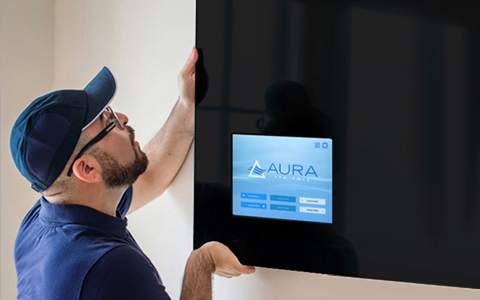
Every AURA unit includes onboard gas sensors that continuously monitor real-time room-level concentrations of ozone and other byproducts, displayed on the unit's 10.1" touchscreen and transmitted to the fleet management dashboard.
Calibrated Sensors
Sensors calibrated to nationally recognized reference standards for measurement accuracy.
Automatic Shutoff
If sensor readings approach threshold values, the system automatically reduces or ceases ROS production.
Remote Fleet Monitoring
WiFi-connected units report sensor data to the management dashboard for facility-wide oversight.
Documents
Request Compliance Documents
Contact us to receive safety data sheets and compliance summaries for your procurement process.
Have compliance questions?
Our team can provide detailed documentation for your regulatory requirements.
Contact Us