Science
Reactive Oxygen Species Technology
The science behind continuous, chemical-free air and surface sterilization — safe enough for occupied spaces, effective enough for critical environments.
What Are ROS?
Nature's Own Sterilizer, Engineered for Precision
Reactive oxygen species (ROS) are naturally occurring molecules with strong oxidizing properties. In the atmosphere, ROS — including ozone (O₃) and hydrogen peroxide (H₂O₂) — play a fundamental role in breaking down organic compounds.
The AURA system harnesses this natural process in a controlled, indoor environment. Our proprietary plasma chamber generates low concentrations of ROS that continuously neutralize airborne and surface-bound pathogens, molds, bacteria, and volatile organic compounds. This approach was first demonstrated by Nikola Tesla in his 1896 patent (US 568,177) for ozone generation — AURA modernizes this principle with precision sensors, intelligent controls, and safety systems that keep concentrations well below regulatory limits.
O₃
Ozone
Powerful oxidizer that disrupts pathogen cell membranes. AURA maintains average output at < 0.05 ppm — half the OSHA limit.
H₂O₂
Hydrogen Peroxide
Surface-active sterilizer at very low concentrations. Average output < 0.07 ppm, well within safe occupancy levels.
OH
Hydroxyl Radicals
Short-lived but extremely effective at breaking down organic pollutants and neutralizing volatile organic compounds.
Inside the Unit
How the AURA Unit Works
A four-stage process from air intake to verified clean air output.
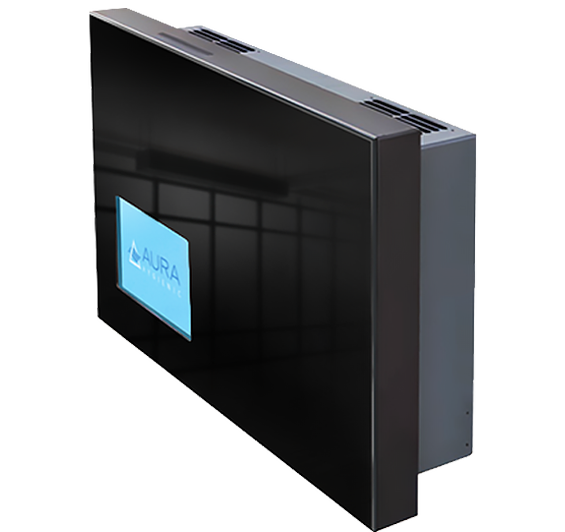
Air Intake
Commercial-grade variable-speed fan draws ambient air into the unit for high-volume circulation.
Plasma Chamber
Air passes through the proprietary plasma chamber where controlled electrical discharge generates reactive oxygen species.
ROS Dispersion
Low-concentration O₃ and H₂O₂ are dispersed into the environment for continuous air and surface sterilization.
Sensor Verification
Onboard calibrated sensors continuously monitor output levels, auto-adjusting or shutting off if thresholds are approached.
Safety by Design
Always Below Regulatory Limits
Per OSHA 29 CFR 1910.1000 Table Z-1, the permissible exposure limit for ozone is 0.10 ppm as an 8-hour time-weighted average. AURA maintains an average output of < 0.05 ppm — 50% of the OSHA limit.
Ozone (O₃) Output
50% below limitHydrogen Peroxide (H₂O₂)
Well within safe rangeAutomatic Safety Shutoff
If sensor readings approach threshold values, the system automatically reduces or stops ROS generation. Calibrated sensors ensure measurement accuracy.
See the technology in action
Request a technical specification sheet or schedule a demo with our team.
Schedule a Demo